Modern construction sites are marvels of human ingenuity, operating as highly choreographed ecosystems where hundreds of moving parts must align flawlessly. However, beneath the surface of this organized chaos lies a reality of razor-thin profit margins and aggressively compressed schedules. In high-stakes commercial and industrial building projects, every single minute of unplanned downtime translates directly into thousands of dollars lost. Within this high-pressure environment, vertical logistics—the physical act of moving massive, heavy materials from the ground to their final elevated positions—often form the absolute critical path for the entire project timeline. If the lifting operations halt, the entire job site grinds to a devastating standstill.
Managing these complex logistics goes far beyond simply pointing to a piece of heavy iron and telling a crew to lift a steel beam. It is an intricate, high-stakes symphony that requires a deep understanding of structural physics, rigorous geotechnical engineering, uncompromising legal compliance, and masterful human coordination. A successful lift is never an accident; it is the culmination of weeks, sometimes months, of meticulous planning and preparation.
Successfully executing massive vertical lifts requires site managers to possess a flawless understanding of their site’s physical limitations. It demands an exact, mathematical match of the machinery to the specific payload being hoisted. Furthermore, it requires the rigorous vetting of equipment partners and an unyielding, zero-tolerance commitment to on-site safety protocols. When these elements are managed proactively, vertical logistics become a seamless operation that drives the project forward. When they are ignored, the results range from costly delays to catastrophic, life-altering structural failures.
Conduct a Rigorous Site and Ground Assessment
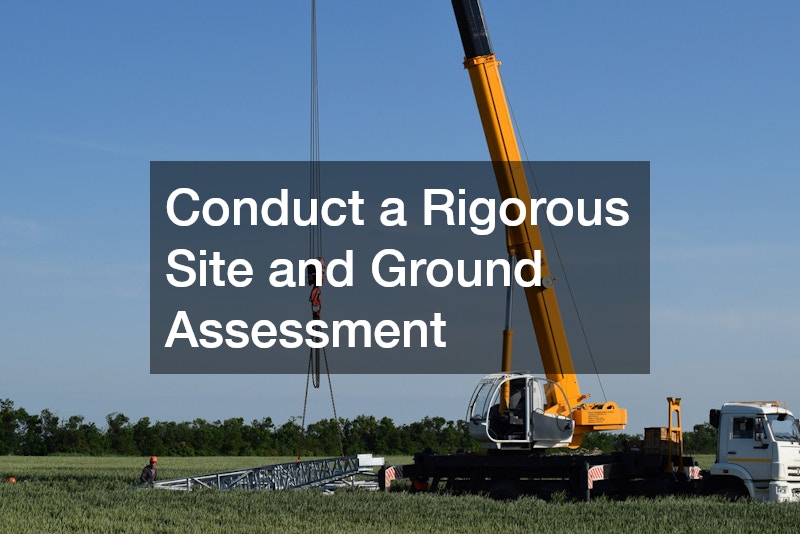
The foundation of any successful heavy lift literally begins with the ground beneath your feet. Before any machinery is mobilized to your job site, you must conduct a highly rigorous, scientifically backed assessment of the terrain. The sheer mass of the machinery required to hoist multi-ton payloads places extraordinary stress on the earth. Evaluating soil compaction and terrain stability is not a step you can afford to estimate. Project managers must bring in geotechnical engineers to test the ground bearing capacity of the staging area. If the soil is overly saturated, loosely packed, or structurally compromised, a massive machine could sink even a fraction of an inch during a critical hoist, shifting its center of gravity and leading to an immediate, catastrophic tip-over.
Beyond the earth itself, you must map out all overhead obstructions and hidden underground utilities. A job site is a three-dimensional puzzle. You must look up to identify high-voltage power lines, low-hanging tree branches, and the proximity of neighboring structures. Then, you must look down. You must identify and map every subterranean vault, water main, gas pipe, and sewer line. The immense ground pressure exerted by lifting machinery can easily crush aging underground infrastructure, causing site-flooding, gas leaks, and massive municipal fines.
Finally, you must carefully plan for the equipment footprint and the necessary swing radius. Standard construction equipment rentals like skid steers or small excavators often require very little ground preparation and can squeeze into tight corners. However, bringing in a massive tracked machine like a crawler crane rental changes the entire dynamic of your site. These colossal machines require extensive, heavy-duty timber matting to distribute their immense weight safely. You must physically measure the staging area to ensure there is adequate room to assemble the boom, extend the stabilizing outriggers to their maximum width, and safely rotate the load a full 360 degrees without interfering with other active trades working nearby.
-
Commission Geotechnical Surveys: Never trust visual inspections of soil. Demand core samples and compaction tests to verify the earth can handle the pounds-per-square-inch pressure of fully loaded outriggers.
-
Implement Utility Buffers: Mark all underground utilities with high-visibility paint and establish physical barricades to prevent heavy tracks or outriggers from resting directly over fragile pipes.
-
Calculate the Assembly Footprint: Remember that the machinery often arrives in pieces on multiple flatbed trucks. You need a designated drop zone just to put the machine together before it ever makes its first lift.

Match the Machinery to Your Specific Lift Profile
Once your staging area is secured and verified, the next critical phase is ensuring you select the precise piece of machinery for the mathematical reality of your specific payload. This is where site managers must become intimately familiar with load charts. A load chart is the operator’s bible; it dictates exactly what a machine can safely lift at various distances. You must calculate the maximum weights of your heaviest picks, but more importantly, you must calculate the radius of the lift. A machine’s lifting capacity drops dramatically the further the boom extends horizontally away from its center of gravity. A machine rated for 100 tons can only lift a fraction of that weight if the load must be placed fifty feet away from the base.
You must also evaluate the mobility needs of your project versus the requirement for heavy, static lifts. The geographical layout and the sequence of your build will dictate your machinery needs. If you are managing a massive highway infrastructure project that requires lifting precast concrete barriers at fifty different locations across a five-mile stretch in a single day, highly mobile machines like cranes for truck are ideal because they can drive on public roads at highway speeds and set up in minutes. Conversely, if you are erecting the central steel core of a sixty-story high-rise building, you need stationary, high-capacity machinery. In these scenarios, contracting dedicated crane services that provide tower equipment fixed to the building’s foundation is the only way to achieve the necessary height and stability.
Environmental factors must also be heavily scrutinized when matching machinery to your profile. Weather, and specifically wind speed, is the great unpredictable variable in vertical logistics. You must account for the “sail area” of your load. Lifting a dense, compact steel beam in a moderate breeze is vastly different from lifting a massive, flat roofing panel. The wind catches the surface area of the panel, creating a sail effect that can violently pull the boom out of alignment and overpower the machine’s rotational brakes.
-
Determine the Critical Pick: Identify the single heaviest and furthest lift of the entire project. Size your machinery based on this worst-case scenario, not the average daily payload.
-
Analyze the Sail Effect: Work with engineers to calculate the wind load resistance of large-surface-area materials, establishing strict wind-speed cutoff limits for your lifting operations.
-
Factor in Boom Deflection: Understand that as heavy loads are applied, the boom will naturally bend and deflect downward, increasing the radius. This must be mathematically accounted for before the load ever leaves the ground.
Vet and Select Reliable Heavy Machinery Partners
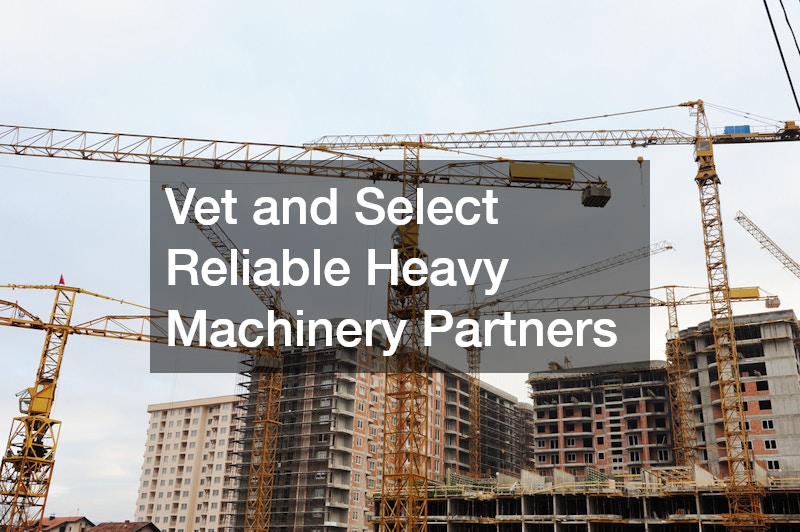
The heavy machinery industry is vast, and the quality of providers varies wildly. Your project’s safety and financial viability are intimately tied to the reliability of the partners you select to supply your lifting equipment. This phase requires rigorous due diligence. You must look beyond the glossy marketing materials and heavily discounted initial quotes to inspect the physical reality of their operations.
Do not sign a contract without physically inspecting the provider’s fleet. Visit their yard. You are looking for signs of a meticulous maintenance culture. The machinery should be clean, well-lubricated, and free of any visible fluid leaks. The tires or tracks should be in excellent condition, and the cabins should be equipped with modern, fully functional computer-aided load monitoring systems (LMIs). A company that cuts corners on the aesthetic and mechanical maintenance of their equipment is highly likely to cut corners on safety protocols.
You must also rigorously verify their legal and safety credentials. Check for valid, up-to-date third-party inspection tags on every piece of equipment that will enter your site. Demand to see their certificates of insurance. Given the catastrophic financial implications of a dropped load or a tipped machine, you must ensure the provider carries adequate, multi-million dollar liability insurance that specifically covers your type of project. When evaluating different national or regional crane companies, request their Experience Modification Rate (EMR), which is a metric used by the insurance industry to gauge a company’s safety record and history of worker’s compensation claims. A low EMR indicates a strong culture of safety.
Finally, prioritize geographical proximity and logistical support readiness. While a massive national conglomerate might offer a slightly lower hourly rate, partnering with a dedicated local crane company often yields significantly better results when things go wrong. If a hydraulic line bursts in the middle of a critical lift, you cannot afford to wait 48 hours for a mechanic to be flown in from across the country. A provider situated close to your job site can dispatch emergency mechanics, deliver replacement parts, or even swap out the entire machine within hours, saving your project from devastating schedule overruns.
-
Review Maintenance Logs: Ask to see the detailed service history of the exact machine assigned to your site, ensuring all preventative maintenance has been performed on schedule.
-
Verify Insurance Exclusions: Have your legal counsel review the provider’s insurance policy to ensure there are no exclusions for the specific height, weight, or type of materials you are lifting.
-
Assess Emergency Response Protocols: Before signing, ask the provider to detail their exact procedure and guaranteed response time in the event of a catastrophic mechanical failure on your site.
Master the Paperwork, Permits, and Scheduling
Logistical mastery is often won or lost in the administrative office long before the machinery ever arrives on the dirt. The sheer size and disruption caused by heavy lifting operations require navigating a dense labyrinth of municipal bureaucracy, complex legal contracts, and hyper-precise scheduling matrices. Failing to master the paperwork will halt your project just as quickly as a mechanical failure.
Securing the right-of-way and finalizing street closure permits must be done weeks, if not months, in advance. Municipal transportation departments are notoriously slow, and you cannot simply block off a busy public road to swing a load of steel over a sidewalk. You must submit detailed traffic rerouting plans, hire off-duty police officers for traffic control, and secure pedestrian canopy permits. When vetting various crane rental companies, ask if their dispatch office will assist in this administrative burden. The best partners have deep, pre-existing relationships with local municipal permit offices and can expedite these approvals.
You must carefully scrutinize your contracts for hidden fees and punitive downtime clauses. A low base rental rate is often a trojan horse for exorbitant accessorial charges. Read the fine print meticulously. How are weather delays billed? If a sudden lightning storm forces a shutdown for three days, are you still paying the full daily rental rate? What are the exact costs for mobilization (delivering and assembling the machine) and demobilization? Are there mandatory overtime rates if a lift runs past 5:00 PM? Top-tier local crane services will offer transparent, flat-rate pricing structures for mobilization and clearly defined weather-day clauses so your budget isn’t blown out of proportion by an unpredictable thunderstorm.
Coordination of delivery timelines with other trades is the final piece of the scheduling puzzle. A massive lifting operation requires “just-in-time” delivery of materials. If you are erecting steel, the flatbed trucks carrying the beams must arrive at the exact moment the lifting team is ready to hoist them. If the trucks arrive too early, they create a massive traffic bottleneck and choke the staging area. If they arrive too late, you are paying hundreds of dollars an hour for a massive machine and a highly paid crew to sit idle.
-
Establish a Permit Matrix: Create a shared digital spreadsheet detailing every required local, state, and federal permit, the filing deadlines, and the agency contact person.
-
Negotiate Weather Clauses: Fiercely negotiate your contract to ensure that acts of God, like high winds or lightning that force a safety shutdown, do not incur full daily rental fees.
-
Implement GPS Tracking for Deliveries: Mandate that all supply trucks carrying heavy materials use GPS tracking so your lift director can see exactly when they will arrive at the site gates.
Prioritize Rigging Safety and Personnel Expertise
The most technologically advanced, perfectly maintained, and mathematically correct lifting machinery in the world is ultimately useless—and highly dangerous—if the human beings operating it and securing the loads are not operating at the absolute highest levels of professional expertise. Safety cannot be a passive concept; it must be an aggressively enforced daily protocol.
Every single shift must begin with a rigorous pre-lift inspection and a comprehensive safety briefing. The lift director, the rigging crew, and the site supervisors must gather for a mandatory “toolbox talk.” This is not a formality; it is a critical alignment meeting where the team reviews the specific weights, shapes, and hazards of the day’s payload. The rigging equipment itself—the wire ropes, synthetic slings, shackles, and spreader bars—must be physically inspected for fraying, bending, or chemical degradation. If a nylon sling has a minor cut, it must be immediately destroyed and discarded, not just set aside.
Clear, unbreakable communication protocols are the lifeline of a lifting operation. The individual operating the machinery is often executing a “blind lift,” meaning they cannot physically see the load being placed on the roof or behind a wall. They are relying entirely on the eyes and instructions of the signal person. You must establish dedicated, interference-free radio channels for the lifting crew. Furthermore, every person involved must be fluent in standardized hand signals to ensure that if the radios fail, the operation can be safely aborted without confusion.
Ultimately, you must verify the credentials and the seasoned experience of the crew. When you contract a crane rental service, you are essentially bringing temporary workers onto your site who hold the lives of your permanent crew in their hands. The machinery is only as safe as the people operating it. You must demand to see the physical certification cards of the crane operators assigned to your site. In the United States, this typically means verifying their National Commission for the Certification of Crane Operators (NCCCO) status. You must also ensure that the riggers—the individuals actually calculating the angles and attaching the loads—hold specific, recognized rigging certifications. Never allow an uncertified laborer to sling a load.
-
Enforce the Stop-Work Authority: Make it abundantly clear during safety briefings that every single person on the site, from the lead engineer to the newest apprentice, has the absolute authority to halt a lift if they see an unsafe condition, with zero fear of reprisal.
-
Audit Rigging Hardware Daily: Implement a color-coded zip-tie system for rigging hardware. If a shackle was inspected on Tuesday, it gets a red tie. This makes it instantly obvious if a piece of hardware missed its daily inspection.
-
Verify Specific Certifications: Ensure that the operator’s certification strictly matches the specific type of machinery they are running. A certification for a small hydraulic truck boom does not legally or practically qualify someone to operate a massive lattice-boom crawler.
Elevating Your Project to Profitable Heights
The successful management of heavy vertical logistics is the ultimate test of a construction manager’s foresight, discipline, and attention to detail. It is a process that leaves absolutely no room for assumptions or shortcuts. As we have explored, the logistical matrix requires a multi-tiered approach: beginning with the literal dirt through intense ground preparation, matching the exact mathematical specifications of the machinery to the payload, aggressively vetting your equipment partners, mastering the bureaucratic permitting process, and upholding unwavering safety protocols on the ground. These are the non-negotiable pillars of a successful lift.
The value of this proactive management cannot be overstated. While this level of intense planning requires significant upfront administrative effort and potentially higher initial planning costs, it is the only reliable way to protect your profit margins. A well-planned lift operates smoothly, keeps subsequent trades on schedule, and prevents the devastating financial drain of idle crews waiting on delayed materials. More importantly, it mitigates the catastrophic physical risks inherent in moving multi-ton objects through the air above a populated job site.
Site managers must view lifting logistics not as a standalone, isolated task to be checked off a list, but as the central, beating heartbeat of the construction schedule. The efficiency and safety of your vertical logistics dictate the pace, the morale, and ultimately the profitability of the entire project. By elevating your planning standards, demanding excellence from your partners, and prioritizing the safety of your personnel above all else, you ensure that your high-stakes build reaches its maximum potential.